





In the rapidly evolving digital economy, the distinction between a business existing online and one dominating its market often comes down to a single asset: their website. We’ve transitioned from an era where sites were a static digital brochure to a new reality where it must function as a 24/7 sales engine, brand ambassador, and data source for Artificial Intelligence (AI).
With global e-commerce sales projecting massive growth and mobile commerce accounting for nearly 60% of retail sales, the stakes have never been higher. Yet, many business owners still grapple with the template vs. custom dilemma, often lured by low upfront costs of pre-made solutions. This approach, however, ignores the seismic shift in how consumers, and now AI search engines, discover and validate businesses.
Drawing on expert insights into digital marketing, technical development, and the new rules of AI search, this article explores why investing in custom website design is a strategic imperative for small to mid-size businesses (SMBs) looking to secure their future.
Key Takeaways
- Customization Wins: Custom sites avoid code bloat and technical debt ensuring long-term scalability and a reported ROI of over 400% for SMEs.
- AI Visibility: Generic templates often fail to provide the deep E-E-A-T signals and structured data required to be cited by AI search engines like Google Gemini.
- Mobile Revenue: With mobile commerce driving nearly 60% of retail sales, fully responsive custom design is critical to preventing the high abandonment rates seen on poorly optimized sites.
- Asset Ownership: Unlike rented social media or leased platforms, custom websites are capital assets you own, protecting your business from algorithm changes and platform shutdowns.
- Trust Economy: Custom designs effectively integrate earned media (reviews), leveraging the fact that 92% of consumers rely on social proof for purchasing decisions.
1. The AI Shift: From Searching to Answering

To understand the value of custom design, one must first understand the environment in which the website operates. The traditional model of Search Engine Optimization (SEO), focusing heavily on keywords and rankings, is being disrupted by AI-powered search engines like Google’s Search Generative Experience (SGE).
A. The Rise of the No-Click Phenomenon
In the past, users searched for a term, saw a list of blue links, and clicked through to find answers. Today, AI search engines provide instant, precise answers via AI Overviews, often resulting in a no-click experience. In this scenario, your website’s primary job shifts from attracting clicks to acting as an authoritative source that AI tools trust enough to cite in their summaries.
Generic template websites often lack structural nuances to communicate this authority. In contrast, a custom website allows for the integration of specific technical signals, including advanced Schema markup, speaking directly to AI agents. If your site cannot be easily read and validated by these algorithms, the business effectively becomes invisible to the modern consumer.
B. E-E-A-T: The New Currency of Trust
Google and AI algorithms evaluate content based on E-E-A-T: Experience, Expertise, Authoritativeness, and Trustworthiness.
- Trustworthiness is the most critical element.
- Experience requires demonstrating firsthand knowledge.
- Authoritativeness relies on citations and recognized standing in the industry.
Custom websites are specifically engineered to highlight these signals. Unlike templates, which force content into rigid blocks, a custom design allows the site to better display case studies, author credentials, and verified reviews in a way that maximizes E-E-A-T scoring. This technical optimization ensures that when an AI engine looks for a trusted local expert, your business is the one recommended.
2. The Template Trap vs. Custom Strategy
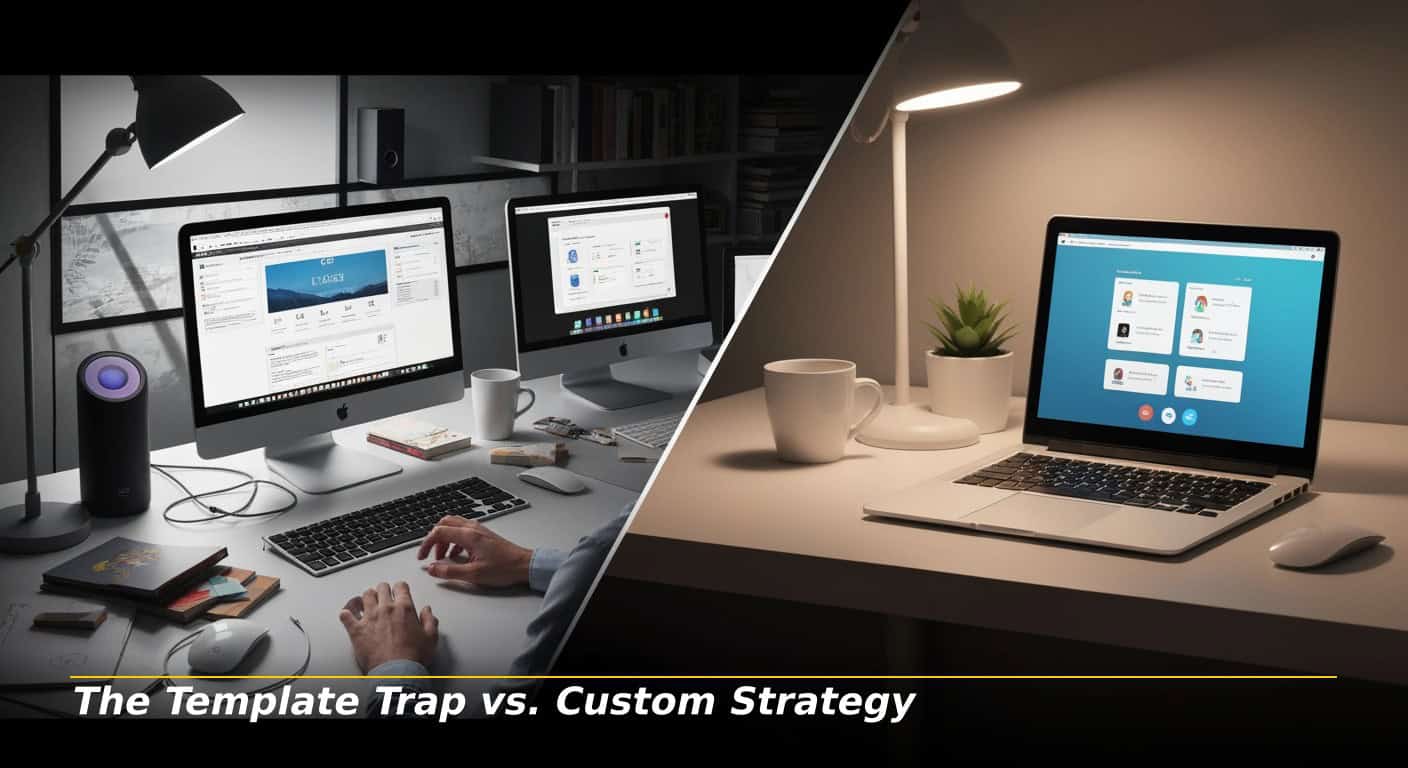
A common misconception among business owners is that a good looking website is synonymous with an effective website. This is a costly fallacy. Templates might look aesthetically pleasing on the surface, but it often harbors hidden liabilities that hinder growth.
A. The Problem with Bloat and Performance
Template websites are designed to appeal to the widest possible audience. To do so, they come packed with features, code, and plugins that you may never use. This phenomenon, known as code bloat, significantly slows down site performance.
- The Speed Penalty: 47% of visitors will abandon a website if it takes longer than two seconds to load.
- The SEO Consequence: Site speed is a direct ranking factor. Bloated templates struggle to achieve the blazing fast results required to rank well in mobile-first indexing.
Custom websites are built with clean code, meaning every line of script serves a specific purpose for your business. Doing so minimizes HTTP requests and leverages caching mechanisms efficiently, resulting in lightning-fast load times retaining visitors and please search algorithms.
B. Scalability and Technical Debt
Choosing a low-cost template often results in technical debt, the implied cost of future rework caused by choosing a patchwork solution now instead of a better approach that would take longer. Templates are rigid; as your business grows, you may find that this cannot integrate with your new CRM, cannot handle increased traffic, or lacks security compatibility. Custom designs are built with scalability in mind.
3. The User Experience (UX) Revenue Multiplier

The ultimate goal of a business website is conversion, turning a visitor into a lead or customer. Custom design focuses intensely on the User Experience (UX) to facilitate this journey.
A. Intent-Based Design
Visitors come to a website with a specific intention: to solve a problem or find information. Custom design processes begin not with a graphic designer, but with a strategic digital marketer who maps out the customer journey based on business goals. By tailoring the layout, navigation, and content specifically to your target audience’s behavior, custom sites reduce friction. Research shows that personalized experiences can increase conversion rates significantly, and a well-designed checkout process can increase sales by 15% or more.
B. The Mobile-First Mandate
With mobile commerce dominating the market, having a responsive website, one capable of adjusting fluidly to any screen size, is non-negotiable.
- The Statistic: 96% of users will abandon a website if the mobile experience is poor.
- The Risk: Half-baked mobile sites don’t only annoy users; they destroy credibility. If a potential client visits your site on their phone and finds broken menus or tiny text, they immediately perceive your business as outdated or untrustworthy.
Custom development ensures that the mobile version of your site is not merely a shrunken desktop version, but a fully optimized experience designed for touch navigation and speed.
4. Ownership, Security, and Asset Value
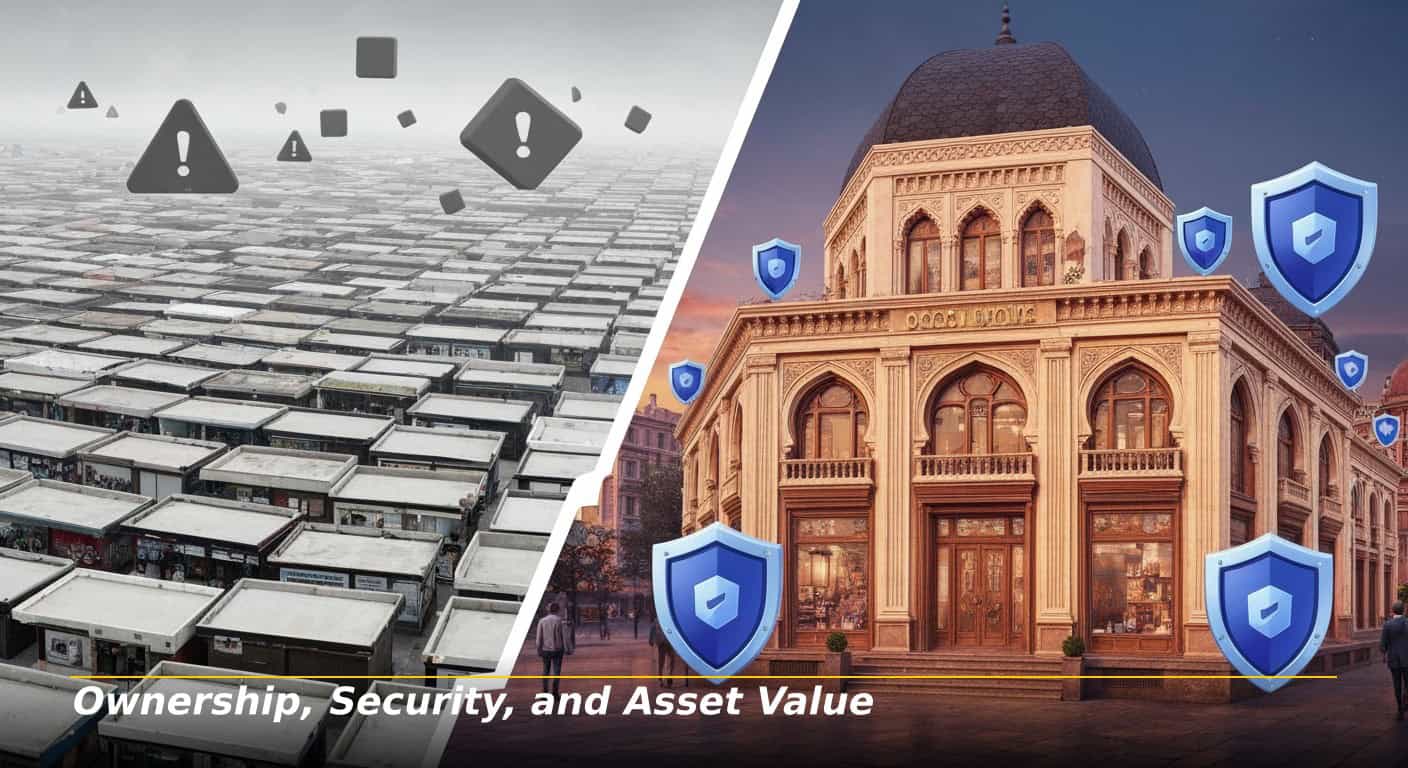
When analyzing the return on investment (ROI), one must view the website as a capital asset, distinct from rented digital channels.
A. The Dangers of Rented Land
Many businesses rely heavily on social media or leased website platforms (where you pay a monthly fee for the template and hosting). The danger here is a lack of control. Algorithms change, ad costs rise, and platforms can shut down accounts without warning. A custom website is an asset you own. You control the content, code, and data. It provides independence from platform policies and ensures that your digital storefront remains open regardless of what happens to Facebook or Instagram.
B. Security as a Trust Signal
Security is a top priority for modern consumers. A template that is used by thousands of other websites is a greater target for hackers; if a vulnerability is found in the template’s code, every site using it is at risk. Custom websites ensure developers can implement tailored security measures, such as specific firewalls and secure database architectures, from the ground up. This bespoke security not only protects your data but also displays trust seals and SSL certificates that are vital for convincing customers to make purchases.
C. The ROI Calculation
While the initial cost of a custom website is higher (typically $3,800 – $9,500 for SMEs) compared to a template, the long-term ROI is significantly superior.
- ROI Timeline: Most businesses see a full return on their investment within 6 to 12 months.
- The Returns: Reported ROI for optimized custom sites can exceed 400% due to higher conversion rates, lower maintenance costs (no fixing broken templates), and improved organic traffic.
5. Reputation Management and the Word-of-Mouse

In the AI era, what others say about you matters more than what you say about yourself. AI search engines treat online reviews and third-party mentions as training data to determine a brand’s sentiment and reliability.
A. The Power of Social Proof
Research found that 92% of customers read online reviews to determine their level of trust in a business. If a website does not effectively showcase these reviews, you are missing a critical psychological trigger for conversion. Custom web design allows for the strategic integration of earned media. Instead of a generic testimonials page, custom sites can pull in real-time feeds from Google Reviews or industry-specific directories, placing social proof at critical decision-making points in the user journey.
B. Managing the Narrative
A robust digital presence helps buffer against negativity. If a business consistently receives bad reviews, it is not a hot-head customer problem; it is a business problem. A custom website strategy implements mechanisms to encourage joyous customers to leave reviews, thereby diluting negative feedback and teaching AI engines that the prevailing sentiment toward the brand is positive. This Word-of-Mouse, sharing experiences online, is the most effective form of modern marketing. By creating a digital experience that delights users (e.g., fast, easy, helpful), businesses encourage customers to become brand advocates.
6. Strategic Implementation for the Digital Mouse
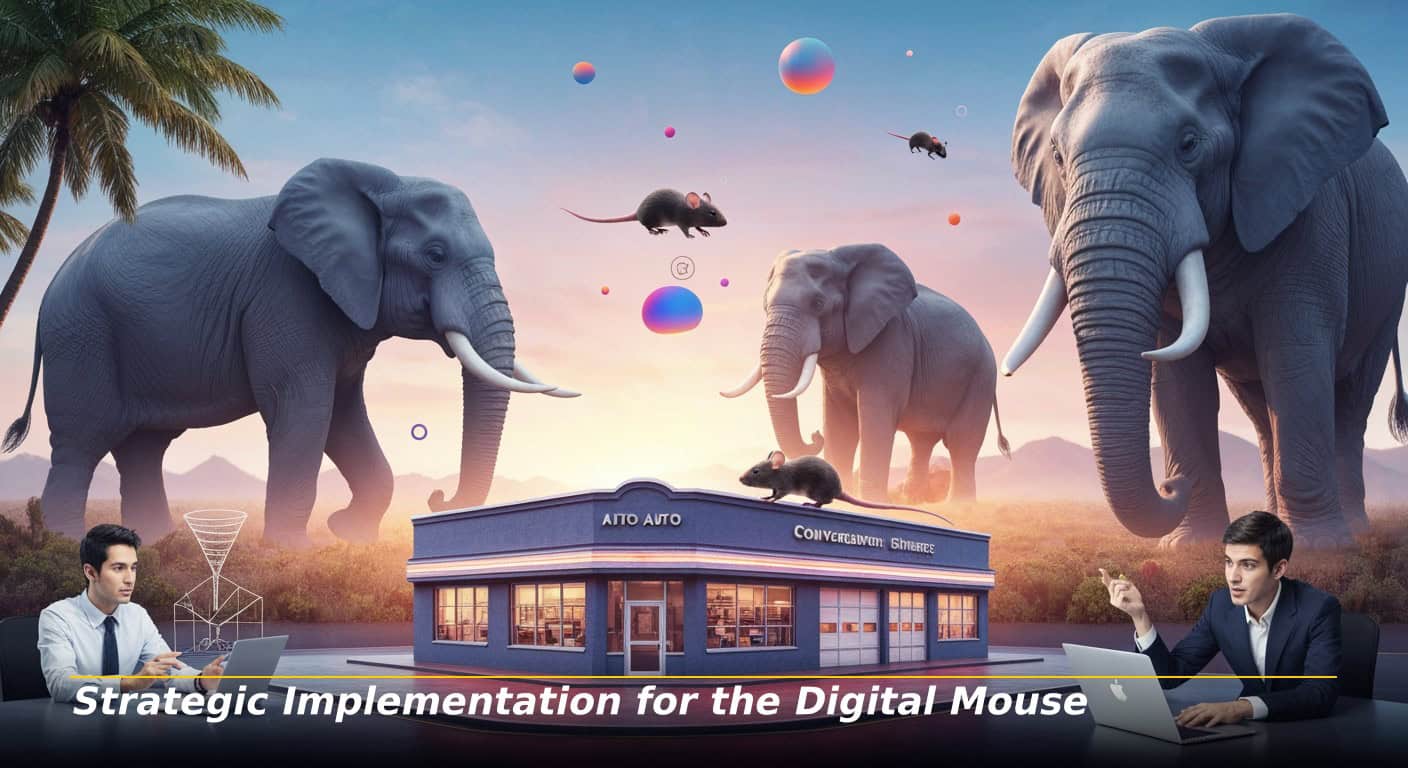
Small businesses often feel like digital mice trying to compete with corporate elephants. However, the agility of a custom website allows SMBs to outmaneuver larger competitors.
A. Niche Dominance
Large corporations often ignore specific niches because they lack the agility to pivot their massive web infrastructure. Custom websites allow an SMB to target specific long-tail keywords and local search intent that established competitors miss. By creating deep, expert content for a specific audience (e.g., “vintage Ford repair in Minneapolis” rather than just “auto repair”), a custom site establishes the “Topical Authority” that AI search engines crave.
B. The Project Management Approach
Successful custom design is not just about coding; it is about business strategy. The most effective workflow involves a digital marketing project manager who first understands the business’s mission and target audience.
- Strategy: The marketer outlines the conversion funnel.
- Design: The designer creates a visual identity that supports the strategy.
- Development: The programmer builds the code to execute the design efficiently.
This sequence ensures that the website is built for the customer, not for the business owner’s vanity.
Conclusion: The Cost of Inaction
In 2026 and beyond, a website is the equivalent of being in the Yellow Pages in the 2000s, it is the baseline expectation for legitimacy. However, simply having a website is no longer enough.
Half-baked or template websites are a liability. It alienates mobile users, confuses AI search engines, and incurs “technical debt” that costs more to fix than to build right the first time. In contrast, a custom website is a wise investment holding quantifiable financial return. It builds a unique brand identity, secures data ownership, and positions the business to be the trusted answer in the age of AI.
For business owners asking, “What is the most effective website design for my business?”, the answer is clear: It is a design that is fully owned, custom-built for the target customer, and engineered to perform in a mobile-first, AI-driven world.
FAQs About Why Custom Website Design is the Ultimate Business Investment in the AI Era
1. Who should lead the web design process: the designer or the marketer?
While it is common to start with a designer, the most advantageous approach begins with a strategic digital marketer. Designers create the visuals, and programmers build the code, but marketers act as the project manager who defines the business mission, target audience, and conversion strategy first. Starting with a marketer ensures the site is built for your customers’ needs rather than just for aesthetic appeal.
2. Is a good looking website enough to convert customers?
No. Many business owners assume that a visually attractive site is automatically effective, but this is a misconception. Visitors arrive with a specific intention, to solve a problem or find information, not to admire the design. If a good looking site does not provide relevant information quickly and intuitively, visitors will leave without taking action. An effective design prioritizes utility and information retrieval over mere decoration.
3. Who is the invisible audience my website must satisfy first?
Before your customers can find you, the website must satisfy Search Engine Spiders. These automated crawlers scan your site to rank your pages. If your custom design does not cater to this audience through helpful content, mobile-friendliness, and proper keyword tagging, any human audience will likely never find your business in the first place.
4. How does a strong brand website reduce Customer Acquisition Costs (CAC)?
Customer Acquisition Costs have risen by 60% in the last five years. A strong, custom-branded website reduces this cost by fostering organic trust and recognition. Consumers are 50% more likely to buy from recognized brands, and established branding allows one to acquire clients through referrals and organic search rather than relying heavily on expensive paid advertising.
5. What should I do if my new website receives negative reviews?
If you receive consistent negative feedback, do not dismiss it as a hot-head customer issue; view it as a business problem. Use this feedback to adjust your services or products. Furthermore, actively ask happy customers for reviews to balance the sentiment. AI search engines analyze the sentiment of these reviews to determine if they should recommend your business, making proactive reputation management essential.
6. How does a custom website improve customer loyalty and lifetime value?
Retention is cheaper than acquisition, and loyal customers spend 67% more per purchase. A custom website can integrate loyalty programs and personalized experiences that generic templates cannot support. By creating a frictionless, memorable great experience for existing clients, you increase their lifetime value and turn them into advocates who spread words of mouse.
7. Why is “earned media” more valuable than self-promotion for AI search?
AI search engines prioritize third-party validation (what others say about you) over what you say about yourself. Earned media, such as press mentions, online reviews, and directory listings, acts as a trust signal that AI uses to verify your authority. Curated strategies focus on generating these external citations to ensure your brand is the one AI recommends.