




For decades, the digital marketplace operated on a consistent premise: if you utilized the right keywords and bought enough links, ranking was inevitable. Businesses often implement a Ptolemaic strategy, believing they were the center of the universe and customers would simply gravitate toward their sites. However, we have entered a Galilean era where the customer is the center of the universe, and your business must orbit any needs, questions, and behaviors.
This shift has been dramatically accelerated by the rise of Artificial Intelligence (AI). Search engines have evolved from lists of blue links into sophisticated answer engines like Google Gemini, ChatGPT, and Perplexity. Now, AI agents act as gatekeepers. They do not look for matching words; they seek out trust. They scour the web to determine who is legitimate and who is merely noise. Consequently, your brand, defined by its reputation, expertise, and technical ownership, is no longer only a marketing asset; it is your primary key to survival.
If your digital presence is built on rented land or generic templates, these are invisible to AI models guiding consumer decisions. To succeed, small to mid-size businesses (SMBs) must cultivate a brand that signals Experience, Expertise, Authoritativeness, and Trustworthiness (E-E-A-T) to both human users and AI bots.
Key Takeaways
- The Intent Shift with Zero-Click Reality: AI has moved search from keyword matching to concept matching, meaning your brand must answer the why behind customer queries. With nearly 60% of searches ending without a click, brand recognition in AI summaries is the new traffic driver.
- E-E-A-T is Mandatory: To be cited by AI, your brand must demonstrate Experience, Expertise, Authoritativeness, and Trustworthiness.
- The Digital Mouse Advantage: Small businesses can outmaneuver corporate elephants by using agile branding and niche expertise.
- Ownership Equals Security: You must own your domain and CMS; renting a template with minimal marketing effort leaves your brand vulnerable to total loss.
- Reviews as Training Data: Online reviews are now data points used to train AI on your brand’s sentiment and reliability.
- The T.R.I. Standard: Partner with agencies grounded in Trust, Relationships, and Integrity to build a sustainable digital future.
1. The AI Filter. Why Generic is Dead
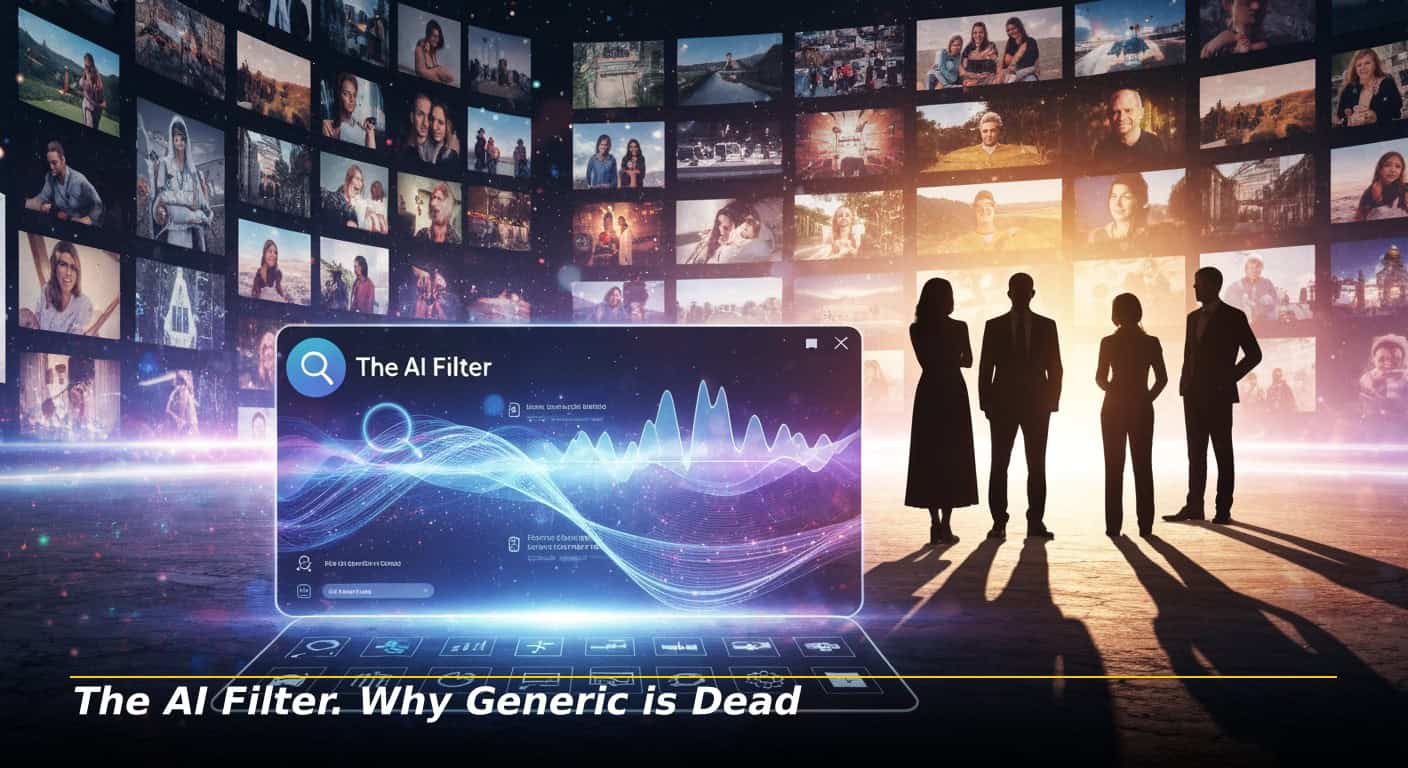
The internet is flooding with AI-generated noise. In response, search engines are becoming stricter filters. Prioritizing brands, they hero ones demonstrating genuine human experience and authority.
A. The Rise of the Answer Engine: Traditionally, a user searched for “best auto repair,” and Google provided a list of shops. Today, users ask complex questions like, “Who is the most reliable mechanic for a vintage Ford in Minneapolis?” AI search engines use Natural Language Processing (NLP) to understand intent and context behind this query. They then synthesize an answer, often without requiring the user to click a link. In 2024, approximately 58.5% of Google searches ended without a click.
This phenomenon, known as zero-click search, means that if your brand is not authoritative enough to be cited in the AI summary (AI Overview), you effectively do not exist for that user. Traffic that does click through is highly qualified, having been pre-vetted by the software.
B. Generative Engine Optimization (GEO): This shift requires a move from traditional SEO to Generative Engine Optimization (GEO). While SEO focuses on keywords, GEO focuses on entities and concepts. AI models view your brand as an entity. If your website is a generic template with copied content, they cannot distinguish you from thousands of others. To be cited, brands must be the definitive source of information in a niche, providing clear, structured answers that can be easily parsed and present.
2. E-E-A-T: The Currency of the AI Era

If content is the vehicle for your marketing, trust is the fuel. Google and other AI systems use a framework called E-E-A-T to evaluate credibility of a brand.
- Experience: AI prioritizes human-first content. Your brand must show it has done the work. This means sharing original case studies, photos of your team, and narratives that only a human could write.
- Expertise: You must demonstrate high skill. Author bios should detail credentials, degrees, and years of practice. AI looks for signs that the content creator is a subject matter expert.
- Authoritativeness: This is about external validation. Are reputable industry sites linking to you? Are you mentioned in local news? These backlinks act as votes of confidence AI uses to measure your brand’s weight in the industry.
- Trustworthiness: This is the most critical component. It involves technical security (HTTPS), transparent contact information, and accurate data. If it cannot verify who you are or where you are located, it will not risk recommending you.
Strategic Implication: A brochure website only listing services lacks depth to establish E-E-A-T. Your site must be a living library of expertise that solves customer problems.
3. The Digital Mouse Strategy
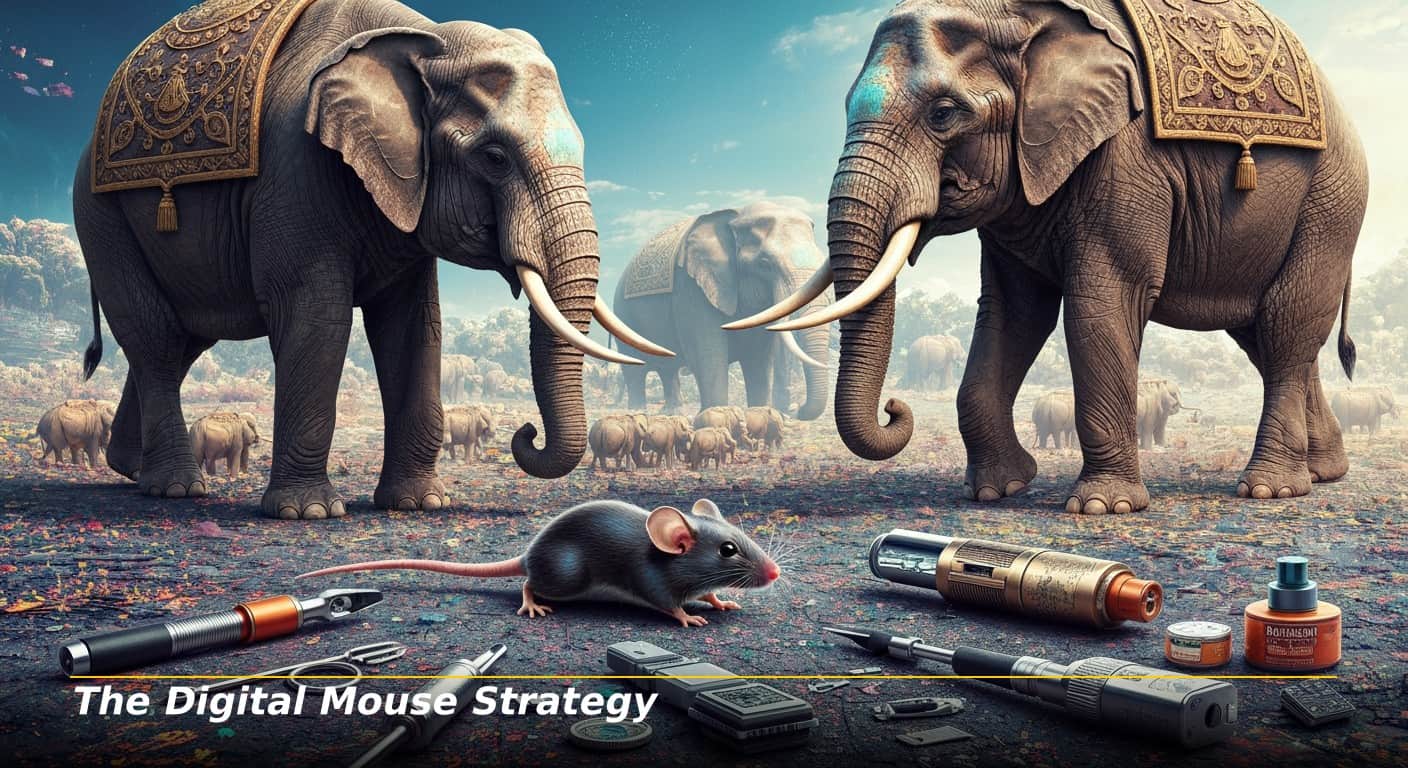
Many small business owners feel intimidated by large, national competitors. They view these corporations as unstoppable giants. However, in the AI era, you should view these competitors as elephants and your business as a digital mouse.
- Agility Over Bureaucracy: Elephants are slow. They are bogged down by bureaucracy, legal reviews, and legacy systems. It takes months to approve a new content strategy or adapt to a Google algorithm update. As a digital mouse, it’s easier to move quickly. You can adopt new AI tools, update your website for mobile responsiveness, and pivot marketing messages over the weekend.
- Niche Dominance: Large corporations often ignore specific niches because the returns are minimal relative to their overhead. This is your opportunity. By becoming specialized and becoming the absolute authority in that narrow space, you can yield positive returns where the elephants cannot compete.
For example, instead of competing on “shoes,” a small brand might dominate “custom orthopedic running shoes for marathons.” AI search is specific; it rewards targeted expertise over broad, shallow content.
4. Technical Branding: Your Website as the Hub

Your brand is not only your logo; it is your digital infrastructure. In the AI era, technical performance is a direct signal of brand quality.
A. The Mobile-First Mandate: Global mobile commerce accounts for 60% of all e-commerce sales. Google has been using mobile-first indexing meaning it judges your brand based primarily on mobile sites. If these are unresponsive, meaning it does not auto-resize for smartphones and tablets, the majority of your audience is alienated. Statistics show that 96% of users will abandon a website if the mobile experience is poor. Non-responsive sites inform AI that your brand is outdated and irrelevant.
B. Speed and Core Web Vitals: AI models and human users share a need for speed. If your site takes more than 10 seconds to load, visitors will leave. Google’s “Core Web Vitals measure metrics like Largest Contentful Paint (LCP), aiming for load times under 2.5 seconds. A slow site is a trust killer. It suggests to the user that your business is inefficient or technically incompetent.
C. The Danger of Renting Your Brand: One of the greatest risks to brand authority is the rental model with minimal marketing efforts. Many low-cost providers offer websites for $15 to $25 a month with such features.
- The Trap: You often do not own the domain name or the content. You are building equity on someone else’s land.
- The Consequence: If you leave the provider, your brand disappears. You lose your history, your backlinks, and your E-E-A-T signals.
- The Solution: You must insist on 100% ownership of your domain and content. Use an open-source Content Management System (CMS) like WordPress, which allows you to move your site to any host you choose.
5. Reputation Management: Feeding the AI

In the past, reviews were social proof for humans. Today, they are training data for machines.
A. Reviews as AI Data Points
AI search engines scan platforms, notably Google Reviews, Yelp, and Facebook, to understand sentiment. It analyzes emotional tone of feedback to determine if a business is reliable. Consistent flow of positive reviews signals to the AI that your business is active and trustworthy.
- Volume and Velocity: AI looks at how many reviews you have and how recently they were posted. A business with 50 reviews from 2018 is seen as less relevant than one with 10 reviews from last month.
- The Word-of-Mouse Effect: Social sharing and online reviews spread six times wider than traditional word-of-mouth.
B. Managing Sentiment
If you consistently receive bad reviews, you do not have a hot-head customer problem; you have a business problem. AI uses sentiment analysis to categorize your brand. If the sentiment is negative, agents will filter you out of recommendations. Proactively asking satisfied customers for reviews and responding to them professionally is essential to shaping the narrative that AI learns about your brand.
6. Selecting the Right Partner: The T.R.I. Standard

Building a brand surviving the AI era is complex. It requires a partner, not a vendor. To find a qualified partner, you must look for the T.R.I. values: Trust, Relationships, and Integrity.
The Vetting Checklist
Use these questions to ensure your partner can build a brand-centric digital presence:
- Eat Your Own Cooking: “Does your agency rank on the top 5 Google AI Overview for your own industry key phrases?” If they cannot build authority for their own brand, they cannot build it for yours.
- Ownership: “Will I legally own my domain name and website content from day one?”
- Empowerment: “Do you specialize in CMS design, and will you coach me on how to make my own updates?” A reliable partner empowers you to control your brand’s voice.
- Full-Service Capability: “Do you handle design, hosting, SEO, and maintenance?” Consolidating these services ensures unified brand strategy and accountability.
- Performance Guarantees: “What kind of guarantee do you have to rank my website in the top 5 of Google AI Overview and ChatGPT for a number of key phrases my target customers would search for my products/services?” A reputable firm should be able to offer specific performance benchmarks based on their expertise.
Conclusion: The Brand is the Business
In the AI era, your brand is the single most powerful asset you possess. It is the beacon that guides AI search engines through the fog of generic content to find you. It is the promise of quality converting a zero-click summary into a loyal customer.
Small businesses have a distinct advantage today. By adopting the Digital Mouse mindset, you can move quickly to implement E-E-A-T principles, optimize for AI searches, and cultivate a sterling reputation through authentic reviews. Do not settle for a half-baked or rented web presence. Invest in a custom, owned, and authoritative digital footprint. By partnering with experts valuing Integrity and Results, you secure your place not only in the AI search results, but in the center of your customer’s universe.
FAQs About Why Your Brand Authority is the Ultimate Defense in the AI Search Era
1. Why is branding more important than SEO in the AI era?
Traditional SEO focused a little more on tricking algorithms with keywords. AI search focuses more on trust. It looks for brands that demonstrate Authoritativeness and Expertise (E-E-A-T). Standout branding signals to the AI that your business is a legitimate, real-world entity that provides value, making it more likely to be cited in answers.
2. What is the Zero-Click phenomenon and how does it affect my brand?
Zero-Click refers to search queries where the user gets their answer directly from the results page (like an AI summary) without clicking a website link. In 2024, nearly 59% of searches were zero-click. This means your brand must be authoritative enough to be mentioned in that summary to get noticed. Traffic that does click is often highly qualified and ready to buy.
3. Why should I avoid renting a website template? When you rent a site (often for $15–$25/month), you typically do not own the domain or the content. You are building a brand on someone else’s property. If you stop paying or want to switch providers, you lose your digital identity. Owning your custom CMS website ensures you control your brand’s destiny and equity.
4. How do online reviews impact my brand’s visibility to AI?
AI uses reviews as training data. It analyzes the sentiment (positive or negative) and the content of reviews to understand what your business does and how well you do it. High volume of recent, positive reviews across multiple platforms (ex. Google, Facebook, Yelp, ) teaches the AI that your brand is trustworthy and relevant.
5. What is the difference between a Brochure Website and an Effective Website?
A brochure website is static and talks about the business, often using generic templates. Effective websites are custom-designed to talk to the customer, answering their questions and solving their problems. Effective websites are structured to convert visitors into leads and are optimized for mobile devices and AI search.
6. How can a small business compete with big brands in AI search?
Small businesses (mice) can beat already-established brands (elephants) by being agile and focusing on niches. Big brands are often slow to adapt to technical changes and ignore smaller, specific markets. By creating deep, expert content for a specific niche, a small brand can establish higher Topical Authority than a generalist corporate competitor.
7. How long does it take to build brand authority online?
Building digital authority is a marathon, not a sprint. While paid ads are instant, building organic trust (SEO/GEO) ideally takes 4 to 6 months of consistent effort. This time allows search engines to crawl your content, verify your technical stability, and recognize your growing reputation through backlinks and reviews.