







The modern business environment is witnessing a seismic shift in how value is exchanged and brands are discovered. For decades, the commercial world operated under a Ptolemaic marketing model(an assumption that a business’s website or physical storefront was the center of the universe) and customers would naturally gravitate toward it. In the AI era, this view is outdated and dangerous. Society has transitioned into a Galilean reality: the customer is now the sun, and your business must orbit their needs, questions, and preferred digital platforms to remain relevant.
Today, the stakes of this digital orbit are immediate. Research indicates that 75% of consumers determine a company’s credibility based solely on its website design, and opinions are formed in a staggering 0.05 seconds. If your digital presence feels like an afterthought, potential clients will click and exit before ever having a chance to state your value. As search engines evolve into sophisticated answer engines powered by Artificial Intelligence, small businesses must stop thinking of their website as a brochure and start treating it as a high-performance growth engine. This guide serves as a strategic map for navigating this transition, helping choose the right partners to build a presence, capture attention, and convert into loyalty.
Key Takeaways
- Customer-Centric Orbit: Move from a business-first perspective to a consumer-first strategy, ensuring content meets users exactly where they search.
- AEO over SEO: Shift focus from simple keyword matching to Answer Engine Optimization to satisfy the intent-based summaries provided by AI agents.
- The E-E-A-T Mandate: Establish unshakeable authority through Experience, Expertise, Authoritativeness, and Trustworthiness to be cited as a definitive resource.
- Mobile-First Necessity: With mobile devices driving 60% of e-commerce, a responsive site that loads in under 3 seconds is a non-negotiable standard for success.
- Ownership and Autonomy: Insist on full ownership of your domain using a Content Management System (CMS) allowing you to update content without constant vendor fees.
- Strategic Vetting: Partner with firms grounded in Trust, Relationships, and Integrity (T.R.I.) who can prove their competence by ranking their own company website.
- Reputation as Currency: Proactively cultivate online reviews, as they serve as primary training data for the AI models that recommend businesses to users.
1. The Evolution of Search: From Links to Answers
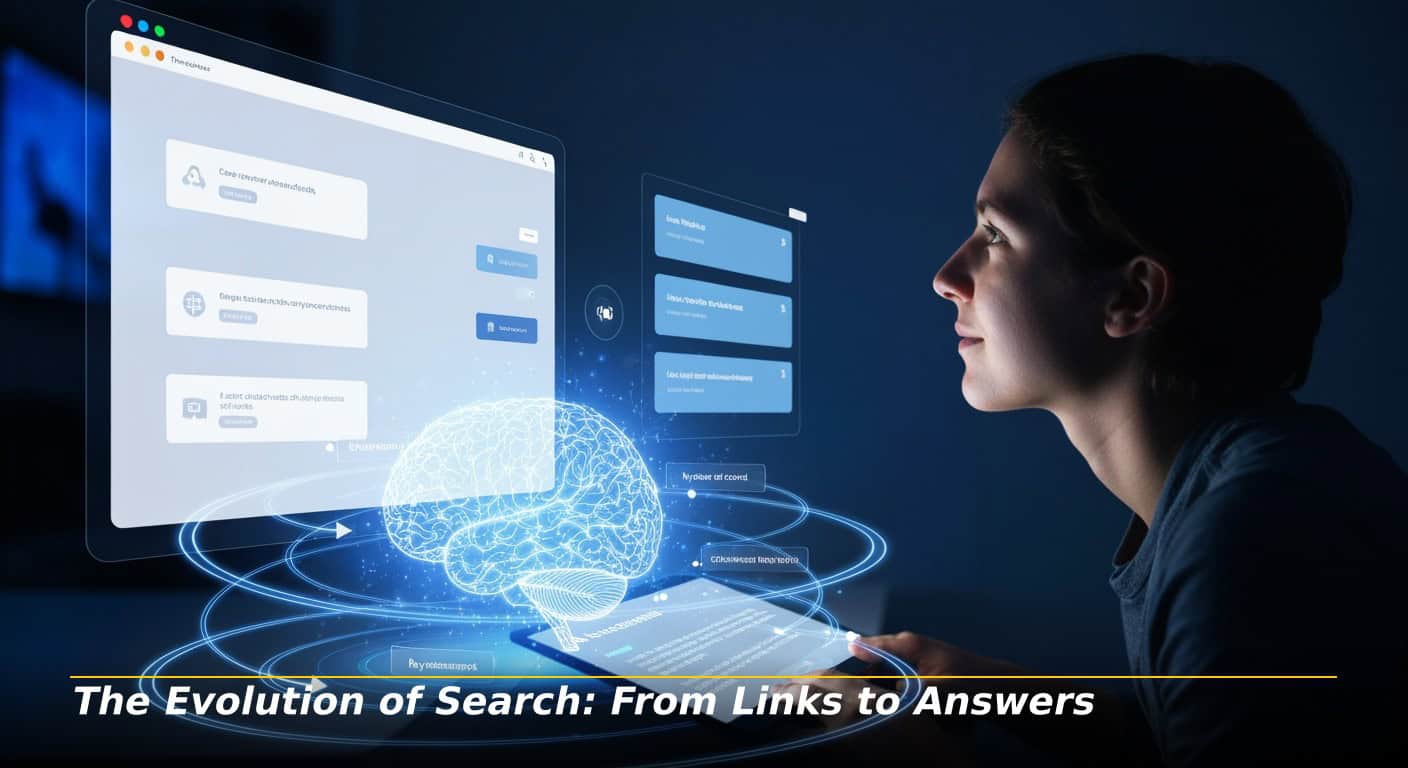
We are currently moving away from the era of ten blue links and toward a world of synthesized information. AI search engines like Google AI Overviews, ChatGPT, and Perplexity no longer point people to pages; they answer questions on your behalf.
A. The Rise of Generative Engine Optimization (GEO)
Traditional SEO was built on exact keyword matching, but modern AI utilizes Natural Language Processing (NLP) to understand human intent. This has birthed the discipline of Generative Engine Optimization. Unlike previous methods, GEO focuses on making content accessible, summarizable, and authoritative enough for AI models to extract facts and cite your brand as the primary source of truth.
B. Navigating the Zero-Click Reality
In 2024, nearly 59% of Google searches ended without a user ever clicking through to a website. This zero-click phenomenon occurs because AI provides the answer directly in the search results. While this initially appears asa loss for traffic, the quality of visitors who do click through is significantly higher. AI acts as a pre-filter, delivering qualified leads who have already seen your brand cited as an expert and are seeking a deeper level of engagement or are ready to finalize a transaction.
2. Mapping Consumer Realities in 2025

Small to mid-size businesses (SMBs) must base their strategies on data findings. The following table highlights the critical trends that define how people shop and search in the current market.
| Trend Category | Key Statistic (2024–2025) | Strategic Business Impact |
| E-Commerce Growth | Global sales are projected at $6.8 trillion by 2025. | Massive opportunity for those with an online store. |
| Mobile Dominance | 60% of e-commerce is driven by smartphones. | Responsive design is the primary ranking factor. |
| AI Engagement | 80% of businesses have embraced AI tech. | Consumer acceptance of AI-assisted shopping is high. |
| Personalization | 65% of consumers prefer tailored experiences. | Content must address specific buyer personas. |
| User Abandonment | 96% leave sites due to poor mobile experiences. | Technical failure is a direct revenue killer. |
3. Content as a Superpower: The E-E-A-T Standard

In the information age, a business is no longer judged by the size of its marketing budget, but by the quality of its knowledge. Content marketing is the bait of your campaign, and AI filters that bait using the E-E-A-T framework.
- Experience: AI prioritizes human-first content. You must prove you have done it by sharing original stories, case studies, and real-world photos.
- Expertise: Highlight that you know it. Include detailed author credentials and professional certifications to validate your advice.
- Authoritativeness: Prove others recognize it. This is built through quality backlinks and being mentioned as a respected source in industry publications.
- Trustworthiness: This is the anchor. It requires a secure site (HTTPS), factual accuracy, and transparent About Us page that clearly states who you are.
By producing relevant, thoughtful content, you establish yourself as a trusted advisor in your trade rather than another provider.
4. The Technical Backbone: Engineering for Performance
Even the best content will fail if it is built on a low-tier website. High-performance design requires a focus on speed, stability, and structure.
A. Core Web Vitals
Google uses Core Web Vitals to quantify the user experience. You must aim for a Largest Contentful Paint (LCP) of 2.5 seconds or less, and an Interaction to Next Paint (INP) of 200 milliseconds or less. Because society has developed short attention spans, a site that takes more than 10 seconds to load is essentially invisible, as most users will exit and move to a competitor.
B. The Language of AI: Structured Data
Structured data (JSON-LD) acts as a direct ranking factor in the AI era. It provides explicit cues helpingAI agents understand exactly what your content means. By using this behind-the-scenes code, you increase chances of appearing in rich results and Knowledge Graphs, making the business more discoverable to voice commands and conversational queries.
5. Building Trust through Word-of-Mouse
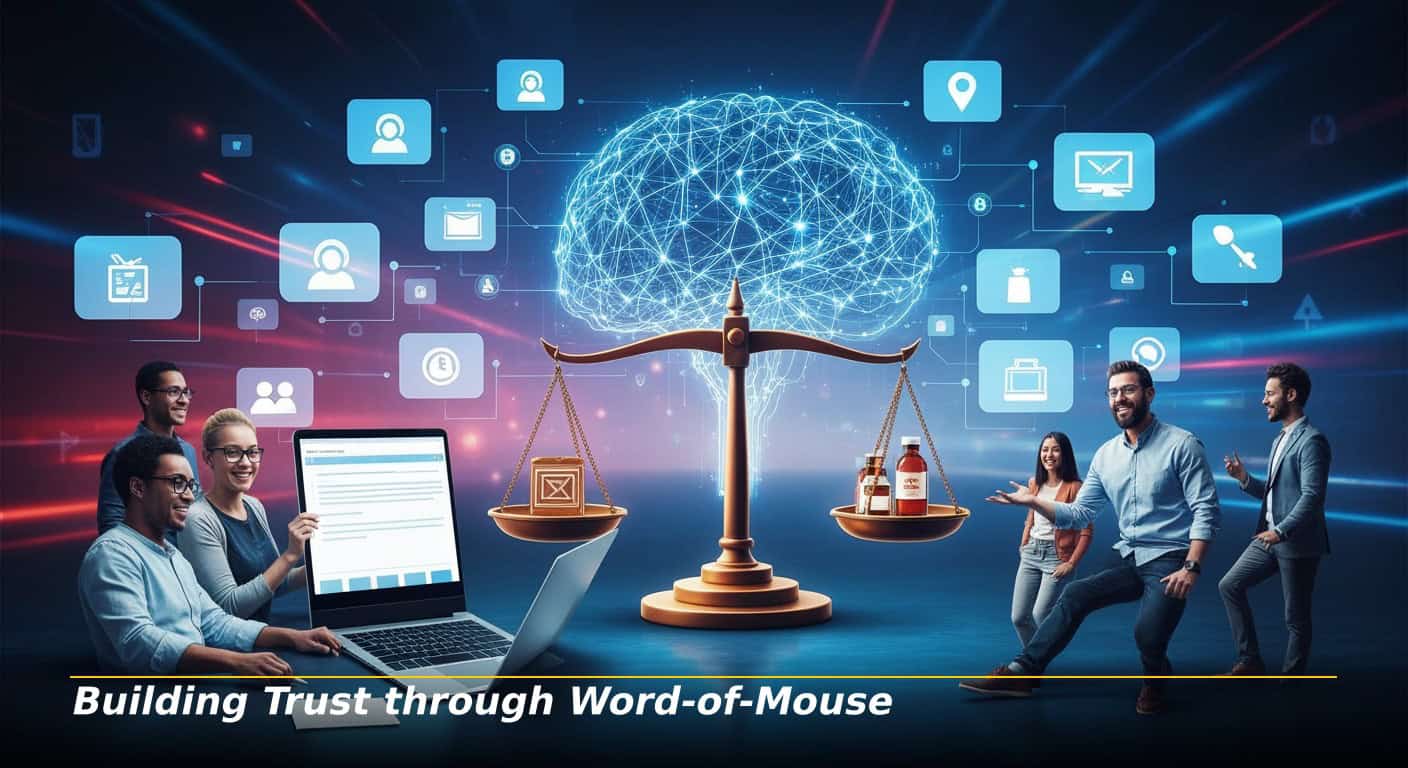
Reputation in the digital age is amplified by what is often called word-of-mouse, the rapid, social-media-shared word-of-mouth spreading six times wider than traditional recommendations.
A. Reviews as AI Training Data
AI systems scan, quote, and summarize your online reviews to determine if you are worth recommending. Research shows that 92% of customers read reviews before trusting a business. Furthermore, the higher the price of your service, the more scrutiny you will face. A customer is inclined to purchase a $10 item without research, but for a $500 purchase, they will seek peer validation. Proactively earning complimentary reviews and responding to them thoughtfully is a critical component of AI search visibility.
B. Sentiment Analysis
AI uses sentiment analysis to determine the emotional tone of your reviews. This allows businesses to utilize feedback as a tool for improvement. If negative reviews are consistent, it suggests a business problem desperately needing strategy shifting. Effectively managing brand sentiment allows you to shape the narrative AI presents to future prospects.
6. The Digital Mouse Strategy for SMBs
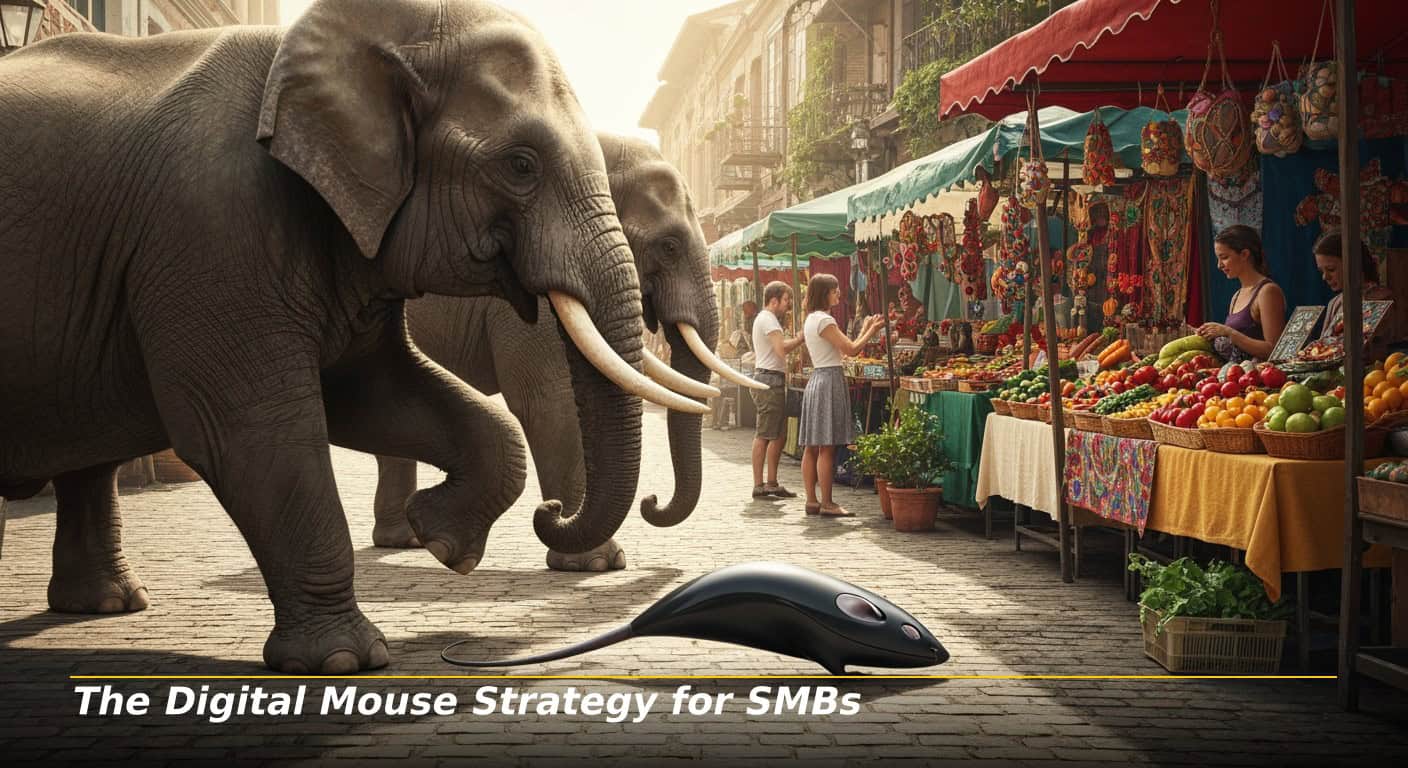
A common mistake is being intimidated by large, big-name competitors. In reality, you should view these giants as elephants, mighty, but slow and burdened by bureaucracy. Small businesses are the digital mouse.
A. Speed and Innovation
It is tough for elephants to implement new changes because they have too many layers of decision-making. As a mouse, you can move faster, adopt newer AI technologies, and pivot strategy in real-time. By staying current with technology shifts and market trends, you can capture market share that larger companies are too slow to protect.
B. Capitalizing on Niche Markets
Large companies often ignore products or services that do not yield high enough returns to satisfy their astounding overhead. SMBs can yield positive returns in specific niches. By establishing yourself as the definitive resource in a specialized area, you build a content moat that deters larger competitors from entering your space.
7. Partner Selection: The T.R.I. Vetting Process

Selecting a web designer is a critical business strategy decision. To ensure you find an exceptional partner, evaluate them based on the core values of Trust, Relationships, and Integrity (T.R.I.).
A. Critical Screening Questions
Before signing any contract, use these criteria to filter out digital fakers:
- Proof of Ranking: “Can you rank your own company website in the top 10 of organic search for your own industry keywords?”
- Domain Ownership: “Will I legally own my domain name, and will it be run on my own URL rather than a sub-domain?”
- CMS Empowerment: “Do you specialize in CMS design, and will you coach me on how to make my own updates so I won’t have to pay a fee every time?”
- Performance Guarantees: “What percentage of keywords (typically 60-80%) can you guarantee will reach the top 10 within 4 to 6 months?”
- Full-Service Integration: “Do you handle design, hosting, SEO, and maintenance under one roof to avoid the middleman headache?”
Conclusion
Navigating this AI search era requires a shift from passive brochure thinking to active, strategic engagement. By centering your digital presence on the customer’s needs, fortifying tech infrastructure, and producing authentic, expert-led content, you transform your website into a pristine 24/7 sales tool. Small businesses that move quickly to adopt these Galilean principles will not only survive the shifts in technology but thrive as definitive voices in their industries. Embrace the power of AI search optimization today to cement your business’s spot in the future of commerce.
FAQs About Dominating AI Search Through Strategic Content and Design
1. What is Answer Engine Optimization (AEO)?
AEO is the process of preparing your website to be the direct source of answers for AI-powered queries. It involves using clear, natural language, structured data, and authoritative content so AI agents including ChatGPT can easily extract and recommend your business to users.
2. Why should I choose custom design over a cheap template?=
A cookie-cutter template blends your identity with thousands of others, making your brand look average and untrustworthy. Custom design is engineered specifically for audience needs, resulting in a significantly higher conversion rate and a professional first impression that differentiates you from the elephants.
3. How does AI impact the value of my website visitors?
Visitors coming from AI summaries are often more desirable than traditional organic traffic. Because AI answers satisfy casual queries, users who click through to your site are typically highly engaged, pre-qualified, and further along in their research or purchase journey.
4. What are the risks of “renting” a website from a hosting company?
Many providers offer seemingly generous $15/month websites that they lease to you. In reality, you often do not own the domain or the content. When attempting to leave, they may hold your site hostage. Always ensure you have a contract stating you have 100% legal ownership of your digital real estate.
5. Why is a domain-based email address important for E-E-A-T?
Using a domain-based email (e.g., [email protected]) proves you are a legitimate source. Using personal emails (e.g., @gmail.com) appears suspicious to new customers and can be seen as spammy by search engine filters, undermining your trustworthiness.
6. Can AI help my business beyond just search visibility?
Yes. AI can help small businesses automate repetitive tasks like scheduling and sorting emails, safeguard data, and improve customer service through automated chatbots solving problems instantly. It acts as a force multiplier for a small team.
7. How long does it take to see results from an AI-driven SEO campaign?
While paid ads are instant, organic AI visibility is a long-term investment. Most professional firms promise measurable improvements in ranking and citations within 4 to 6 months. Real business value builds over years as content compounds in authority.
