







In the modern commercial landscape, business websites are no longer static digital flyers, they are primary engines of any company’s growth. We have transitioned from the previous Field of Dreams mentality, a mistaken belief that “if you build it, they will come”, to a reality where your site must actively fight for attention in a crowded, AI-driven marketplace. Today, your digital presence must function as a high-performance 24/7 Sales Engine, accessible instantly via smartphones and interpreted by sophisticated AI search agents.
Despite this shift, many business owners still approach web design with a bargain bin mentality, viewing it as an administrative expense rather than strategic asset. Research found that 75% of consumers judge a company’s credibility based on its website design, forming that opinion in a measly 0.05 seconds. If your site is slow, unresponsive, or generic, you are not saving money, but actively repelling revenue.
Whether you are a startup acting as a digital mouse trying to outmaneuver corporate elephants, or an established firm, understanding the true cost of web design is critical. This guide breaks down financial tiers, hidden costs of cheap solutions, and value of partnering with a team grounded in Trust, Relationships, and Integrity (T.R.I.).
Key Takeaways
- Price vs. Value: Web design costs range from $50 for templates to $30,000+ for custom builds, but the return on investment depends entirely on ownership and conversion capability.
- The Rental Trap: Avoid leasing websites for low monthly fees (e.g., $15–$25/month); you often do not own the domain or content, leaving your digital asset vulnerable to being held hostage.
- Mobile Is Money: With 60% of e-commerce driven by smartphones, a responsive design is mandatory; 96% of users abandon sites with poor mobile experiences.
- CMS Empowerment: Invest in a Content Management System (CMS) like WordPress that allows you to own your data and update content without paying a developer for every change.
- The “Race Car” Reality: A website is like a race car; building it is only the first cost. To win, you must invest in the pit crew (SEO and maintenance) to keep it running at top speed.
- Vetting for Integrity: Choose a partner based on T.R.I. values (Trust, Relationships, Integrity) ranking their own website highly; if they can’t rank themselves, they can’t rank you.
1. The Three Tiers of Web Design Pricing
When asking “How much does a website cost?”, the answer depends entirely on your goals. Pricing generally falls into three distinct categories, each serving a different purpose and offering different levels of ownership.
Tier 1: The “Brochure” or Template Website ($50 – $600)
This is the entry-level tier, often marketed to budget-conscious startups who want an online presence” quickly.
- The Model: These are often cookie-cutter templates duplicated and sold to thousands of customers. You typically select a pre-designed layout and populate the content yourself.
- The Rental Risk: Many providers in this tier operate on a leasing model, charging small monthly fees ($15–$25) for hosting and templates. The danger is you often do not own the site or the domain. If you stop paying, this digital presence disappears. Support is usually minimal, and you may wait in long queues for assistance.
- The Verdict: While functional for a hobbyist, these sites struggle to stand out in a saturated market. They are digital brochures talking about you but rarely engage with the customer effectively.
Tier 2: The Professional CMS Website ($2,500 – $7,000)
This is the sweet spot for most small to mid-sized businesses (SMBs) looking to compete effectively and own their assets.
- The Model: This involves a professional agency customizing a robust Content Management System (CMS) like WordPress to fit your specific brand. It balances cost-efficiency with professional performance.
- The Value: You get a site that is mobile-responsive, AI-search-engine friendly, and tailored to your audience. Crucially, a successful provider in this tier will empower you by coaching on how to make updates, ensuring you aren’t reliant on them for minor text changes.
- Ownership: Unlike the rental model, you generally own the domain and the content from day one, protecting your digital real estate.
Tier 3: Custom & Enterprise Development ($10,000 – $30,000+)
This tier is for organizations requiring unique functionality, complex databases, or high-end brand differentiation.
- The Model: Every element is built from the ground up. It includes deep strategy sessions, custom programming, advanced e-commerce integrations, and high-level security protocols.
- The Outcome: These sites are engineered for high-volume traffic and complex user journeys. They often include advanced marketing integrations and ongoing retainer support for SEO and content strategy.
2. The High Cost of Cheap. Avoiding Technical Debt

It is tempting to choose the lowest bid, but in the digital world, cheapness often results in technical debt, future costs incurred to fix poor initial work. Low upfront costs can become the most expensive mistake a business makes if it fails to convert visitors.
A. The Domain Ownership Trap
One of the most dangerous cost-cutting mistakes is allowing a provider to register your domain name under their own account to save a few dollars or simplify the process.
- The Scenario: You pay a provider to build your site, and they run it on a sub-domain (e.g., YourBusinessName.ProviderName.com) or register the domain in their name.
- The Consequence: You are building their asset, not yours. If their server crashes, you go offline. If planning to switch vendors, they can hold your domain hostage. Always ensure there’s a contract stating you are the legal owner of your domain.
B. The Mobile Abandonment Factor
Cheap templates often fail to adapt perfectly to all devices, which is a fatal flaw in the current market.
- The Stat: Global mobile commerce is driving 60% of sales, and 96% of users will abandon a website if it offers a poor mobile experience.
- The Cost: If you save $2,000 on a website build but lose 96% of your mobile traffic due to poor design, this is not an asset; it is a liability. A responsive design optimized for AI search engines and auto-resizes for desktops, tablets, and smartphones is non-negotiable.
C. Speed and Hosting
Budget hosting ($15/month) often puts your site on crowded servers.
- The Rule: Users expect sites to load in under 3 seconds. If it takes longer than 10 seconds, visitors leave.
- The Solution: Investing in premium hosting ensures security (SSL) and speed, which are direct ranking factors for Google and AI search engines.
3. E-Commerce and Functionality Costs
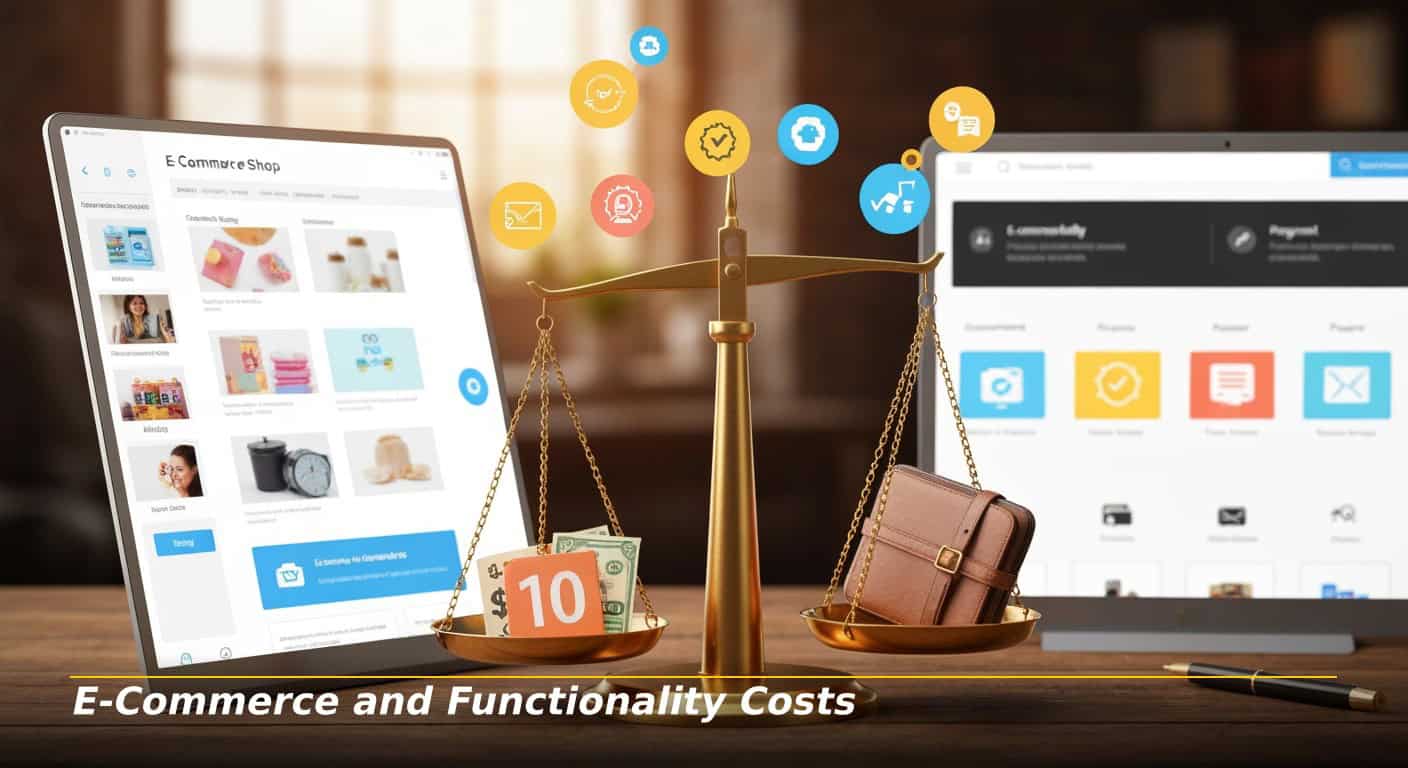
If your goal is to sell products online, the complexity, and cost increases. You are building a digital store, which requires security, inventory management, and payment processing.
A. Platform Selection: WordPress vs. Shopify
- WordPress (WooCommerce): Ideal for businesses wanting full ownership and flexibility. It allows for deep customization and content marketing integration (blogs, SEO) but requires additional maintenance.
- Shopify: A streamlined, rented platform that handles hosting and payments for a monthly fee. Ideal for pure retail, this offers less control over the underlying code compared to an open-source CMS.
B. The Trust Factor in Sales
Transaction value dictates the need for social proof. If you are selling a $10 item, a simple site might suffice. If the item costs $200, customers will rigorously check reviews and site security before buying. Integrating systems to gather and display reviews is a necessary cost for high-ticket items, as 92% of customers read online reviews before making a purchase.
4. The AI & SEO Investment. The Race Car Analogy
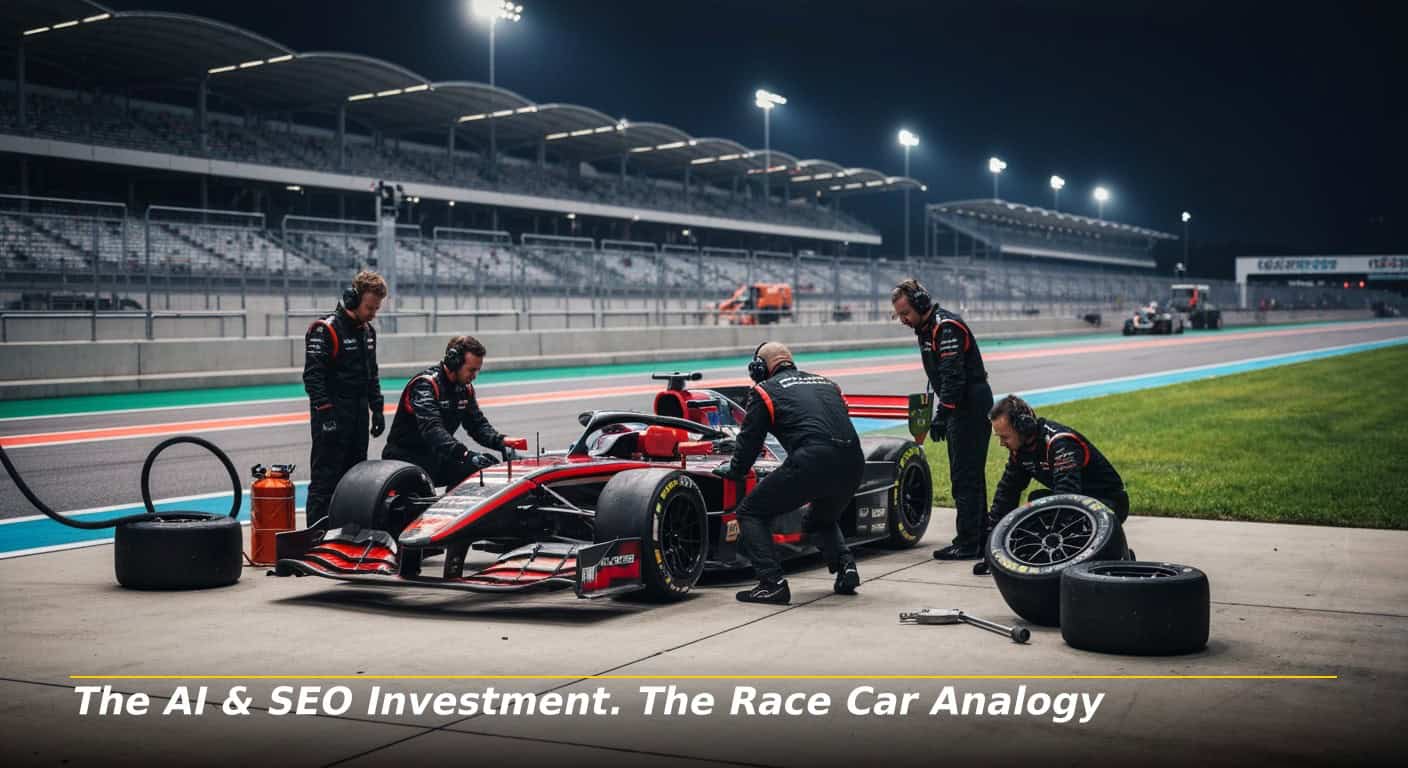
A website that cannot be found is like a billboard in a basement. The cost of web design must include Answer Engine Optimization (AEO), preparing your site to be cited by AI tools like ChatGPT and Google Gemini.
To understand the cost of SEO (Search Engine Optimization), think of it as a professional car race:
- The Website (The Car): Your design investment builds the vehicle. Content is the engine, code is the body.
- SEO (The Pit Crew): You need a team to maintain the car (On-page SEO) and navigate track conditions (Off-page SEO).
- The Maintenance Fee: Just as a race car needs fuel and tires, a website needs ongoing SEO to stay in the top 10. You cannot pay once and expect to win forever; competitors are constantly trying to pass you.
Structured Data and E-E-A-T
Modern web design requires behind-the-scenes code called Structured Data. This helps AI engines understand your business hours, products, and location. Furthermore, content must demonstrate E-E-A-T (Experience, Expertise, Authoritativeness, and Trustworthiness). Cheap templates cannot provide the content strategy required to signal these virtues to AI.
5. Strategic Partner Selection: The T.R.I. Standard

Choosing a web designer is a business strategy decision. To avoid scammers and unqualified freelancers, apply the T.R.I. standard: Trust, Relationships, and Integrity.
A. The Eat Your Own Cooking Test
The most reliable way to judge a web design firm is to check their own performance.
- The Test: Search for “Web Design [Your City]” or “SEO [Your City].” Does the agency rank on the first page?
- The Logic: If they cannot rank their own business, they rarely have the skill to rank yours. This filters out brokers outsourcing work to third parties.
B. Vetting Checklist
Before signing a contract, ask these critical questions to assess value:
- Ownership: “Will I legally own my domain name and website content?”.
- CMS Coaching: “Do you provide coaching so I can update the site myself?” (This saves long-term costs).
- Responsiveness: “Do you test the site on all major browsers and mobile devices?”.
- Guarantees: “What performance guarantees do you offer regarding SEO rankings?” (A solid firm can often guarantee 60-80% of keywords will rank in 4-6 months).
- Full Service: “Do you handle design, hosting, and marketing under one roof?” (Consolidation saves administrative headaches).
6. The Digital Mouse Strategy

Small businesses often feel intimidated by big-box competitors, viewing them as massive Elephants. However, the internet levels the playing field.
- The Strategy: As a digital mouse, you can move faster than the elephant. Large companies are bogged down by bureaucracy and cannot adapt quickly to current AI trends or niche markets.
- The Execution: By investing in a custom CMS website (Tier 2) and focusing on targeted content that big competitors ignore, you can dominate local search results and capture high-value leads.
Conclusion
The question “How much does a website cost?” is better phrased as “How much does it cost to build a 24/7 sales engine?” While it’s possible torent a template for peanuts, the lack of ownership, poor mobile performance, and invisibility to AI search engines often makes this the most expensive option in the long run due to lost opportunity.
For most businesses, investing $2,500 to $7,000 in a custom CMS website, built by a partner who values Integrity, empowers you with Ownership, and understands the AI landscape—offers the best return on investment. This asset will serve as the hub of your business, attracting customers, building trust, and converting traffic into revenue for years to come.
FAQs About Strategic Investment: Understanding Web Design Costs in the AI Era
1. Why do website quotes vary so much (e.g., $500 vs. $5,000)?
Quotes vary based on whether the provider is offering a product or solution. A $500 quote is typically for a pre-made template (product) with no strategy, ownership risks, or support. $5,000 quotes typically includes custom strategy, mobile optimization, SEO foundations, content creation, and full ownership of the digital asset.
2. What are the ongoing costs of a website after it is built?
A website is not a one-time purchase; it requires care. Ongoing costs include:
- Hosting & Security: ($20-$50+/month) for fast servers and SSL certificates.
- Maintenance: Security patches and CMS updates to prevent hacking.
- Marketing/SEO: Monthly retainers to maintain rankings against competitors.
3. Should I choose a monthly subscription or a fixed-price contract?
- Fixed-Price: Best for well-defined projects where you want budget certainty and ownership upfront.
- Monthly Subscription: Useful for businesses that want to spread costs out, but be careful, ensure the contract states you own the site after a certain period, rather than renting indefinitely.
4. Why is mobile responsiveness a non-negotiable cost?
With 60% of traffic coming from mobile devices, a site that isn’t mobile-friendly will alienate the majority of your audience. Search engines like Google also use mobile-first indexing, meaning they judge your site based on its mobile version. If it’s not responsive, you won’t rank.
5. Can I just use a free social media page instead of a website?
Social media is powerful, but you do not own it. Algorithms change, and reach can vanish overnight. A website is owned media, digital real estate that you control. It serves as the central hub where you convert the interest generated by social media into actual sales.
6. What is the difference between a Brochure Website and an Effective Website?
A brochure website is static and talks about you, much like a paper flyer. An effective website is dynamic and talks to the customer. Effective sites answer user questions immediately, load swiftly, and guide the visitor toward a specific action (like calling or buying), resulting in higher conversion rates.
7. How long does it take to build a professional website?
Standard professional websites usually take 4 to 7 weeks to complete. This includes discovery, design, development, and content integration. Complex e-commerce sites or custom applications can take 7 to 12+ weeks. Delays often occur due to waiting for content or feedback from clients.
